Research
My current research examines the limits of human perception and how ecological processes can be observed, documented, and interpreted through artistic experimentation. I am interested in environmental phenomena that exist beyond ordinary human awareness, and in how changes of scale, material transformation, and photographic processes can make these phenomena perceptible.
My experiments bring biological processes, found materials, photography, and sculpture into relation with one another. I explore how growth, accumulation, movement, decay, and transformation can generate new forms and images, often allowing processes to develop beyond complete human control. Through these experiments, I consider how humans construct an understanding of the environments we inhabit and how artistic processes might offer alternative ways of encountering them.
This research is grounded in an ongoing investigation of human and non-human relationships, material agency, and the ways ecological systems emerge through interaction. I am particularly interested in how artistic experimentation can expand perception without simply reproducing scientific methods, creating new ways of observing and engaging with processes that operate outside the scale and limits of human experience.
Ongoing Investigations
Experimental Film
Growth and Transformation of Imagery
This work explores the growth and transformation of imagery through biological processes, material change, and photographic experimentation. I often use expired and degraded film for its unique properties, allowing age, chemical change, and environmental conditions to become part of the image-making process. Rather than functioning only as a surface for recording an image, the film negative becomes a sculptural material and a site for biological interaction, where organisms can grow across and alter its physical structure over time.
In Left Hand, a film negative was placed in a petri dish with the microspore Pestalotiopsis microspora, allowing the organism to engage directly with the film. As the polyurethane-digesting microspore grew, it began to degrade the plastic material of the negative. The altered negative was then removed and scanned, preserving the physical transformation while allowing the resulting imagery to be magnified and reprinted at a larger scale. Through this process, a biological interaction occurring at a microscopic scale is transformed into an image encountered at human scale, shifting the negative from a photographic medium into both a site of growth and a record of material change.


Left Hand
Environmental Photography
Scale, Documentation, Movement
This work examines how photography can document and reveal relationships between human and non-human systems through changes in scale, perspective, time, and movement. I photograph landscapes, materials, structures, and environmental traces while considering the forces and processes that shape them over time. I use aerial photography, long exposures, slow shutter speeds, and double exposures to expand photographic documentation, allowing movement, duration, and multiple perspectives to become part of the image.
In Belfast Reservoir Number 2, I used a drone to photograph the reservoir from above, shifting the scale and perspective of the landscape to document its patterns, boundaries, and systems of movement. In other works, long exposures and slow shutter speeds introduce blur and movement into the image, allowing the passage of time and physical motion to become visible within a single frame. Double exposures bring multiple moments or perspectives together, creating images that move beyond a single fixed representation of place. I am similarly interested in landscapes shaped by larger geological and environmental forces, such as Litli-Hrutur Volcano, where photography becomes a means of documenting a site undergoing ongoing transformation.
Across these works, photography functions both as a tool for environmental documentation and as a means of altering perception, making processes of movement, transformation, and relationships within environments more perceptible.

Reservoir Number 2

Litli-Hrútur, 2023
Material Assemblages
Layering, Interaction, and Transformation
This work explores how materials form new relationships through layering, accumulation, and interaction. I collect and gather materials over extended periods, allowing their physical qualities, histories, and relationships to influence the development of sculptural forms. In works such as Geotrop, these materials are brought together through processes of grouping, layering, and arrangement, creating structures that suggest movement, growth, and transformation.
Rather than treating sculpture as a fixed composition, I consider these works as assemblages in which materials interact and generate new relationships. The resulting forms remain open to change, allowing accumulation, movement, and material interaction to become part of the work's development.

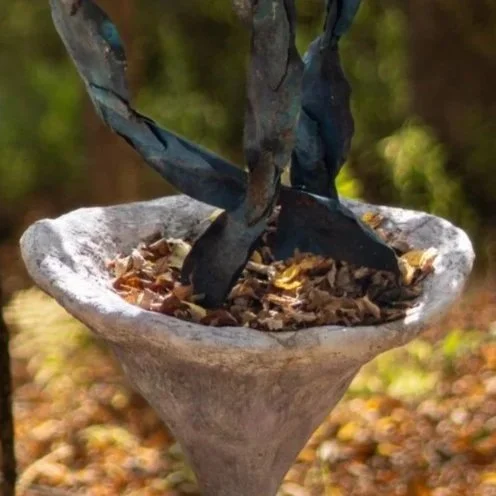
Geotrop